
Lesson #5: Mastering 'Voice'

Whether you’re writing a scene of high conflict or introducing characters at a quiet point in your story, ‘voice’ is important. How your characters express themselves over time gives readers an overarching impression of their unique traits.
A character's 'voice', their distinctive way of speaking, may reveal:
- Personality
- Current mood or psychological state
- Background
- Key differences between them and other characters. These differences may be the seeds of attraction or repulsion
Let's consider a classic example: The untrustworthy guide Gollum (also called Sméagol) in J.R. R. Tolkien’s The Lord of the Rings.
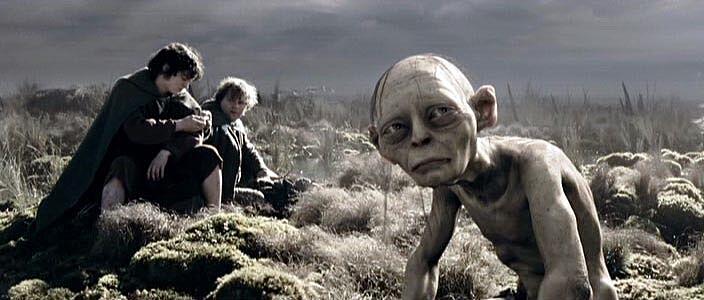
Tolkien makes Gollum’s expression differ so starkly from the language of other character groups, such as the Hobbits and Elves. In this extract from The Two Towers, Frodo and Sam spy the skulking Gollum down a rocky outcrop.
He was getting lower now and the hisses became sharper and clearer.
“Where iss it, where iss it: my Precious, my Precious? It’s ours, it is, and we wants it. The thieves, the thieves, the filthy little thieves. Where are they with my Precious? Curse them! We hates them.”
“It doesn’t sound as if he knew we were here, does it?” whispered Sam. “And what’s his Precious? Does he mean the —”
Gollum’s ‘Precious’ — the ring Frodo and Sam must destroy, that Gollum once murdered his friend to claim — is an object of constant obsession. Gollum even talks to the ring in its absence, illustrating its complete power over him.
Let’s look at how Gollum’s voice differs from the Hobbits:
- Tolkien adds extra sibilant syllables (‘sss’), making Gollum’s speech snake-like, hissing. This emphasizes the inhuman state Gollum has been reduced to by the corrupting power of the ring.
- Gollum’s speech is repetitive and manic, conveying his single-minded obsession
- Gollum refers to himself in the first-person plural (‘we’ and ‘our’), further showing his troubled, wild state of mind.
- Note, too, the striking contrast between Gollum’s fragmented, repetitive voice and Sam’s lucid, flowing voice. Tolkien has made every detail of Gollum’s corruption by the ring stand out, down to the details of his phrasing and pronunciation.
A character doesn’t have to speak like the snake Kaa from Disney’s The Jungle Book to convey malevolence or sneakiness. Wickedness can arise out of the fact they speak almost exactly like a ‘good’ character but carry out sudden, alarming acts of violence.
Even so, think about differences in how characters express themselves. Varying regional accents, slang, or culturally specific idioms will give your story a more diverse, believable cast.
Practical steps
Pick up a novel that contains different human and non-human races (such as a high fantasy novel) or that includes characters from different cultural backgrounds. Flip through and find dialogue. Ask:
- How (if at all) does the author make characters’ voices different?
- Do some use slang more than others?
- Are characters’ accents/vocabularies different?
- Is one character a chatterbox and the other more silent? Note all identifiable differences
- What do the details of how characters express themselves, such as their favorite expressions or the attitude with which they say things (e.g. sarcastically), say about them?
Exercise
Imagine two characters from radically different countries, cultures, or mythological races. Write a few lines of dialogue between them, about anything. Let your imagination run wild. Just focus on making each character’s voice unique. Is each character kind-natured or cruel; proud or timid? How do you express this in their speech without directly telling the reader these details.
Enjoy creating your own believable voices. Tomorrow we’ll examine a sub-topic of voice in more detail: accents and dialects and their uses.
Bridget
Recommended Resources
- Voice & Viewpoint: How to Choose the Right Narrator for Your Novel (blog post)
- How to Refine the "Voice" of Your Book (video)
Brought to you by Now Novel and Bridget McNulty
Bridget McNulty is a published author, editor and writing coach. She co-founded Now Novel to help aspiring authors finish writing their books. Now Novel offers author coaching, a step-by-step brainstorming process for finding story ideas and outlining, short writing courses (including ‘How to Write Dialogue’) and a friendly critique community where authors of all interests and experience levels gather to share and hone their craft.

|
|||
|
Top publishing professionals can help make your writing dreams a reality. Sign up to meet them. |
|


Copyright © 2026 Reedsy, All rights reserved.